
Incentives for Clean Energy Projects
Available incentives can play a major role in reducing the cost of clean energy projects. From residential solar programs to commercial tax credits and community solar opportunities, these incentives help improve project economics and long-term value. Highmark Power works with clients to understand eligibility and design systems that align with available programs.
Pollution Probe’s CHARGED Program - NS & NL
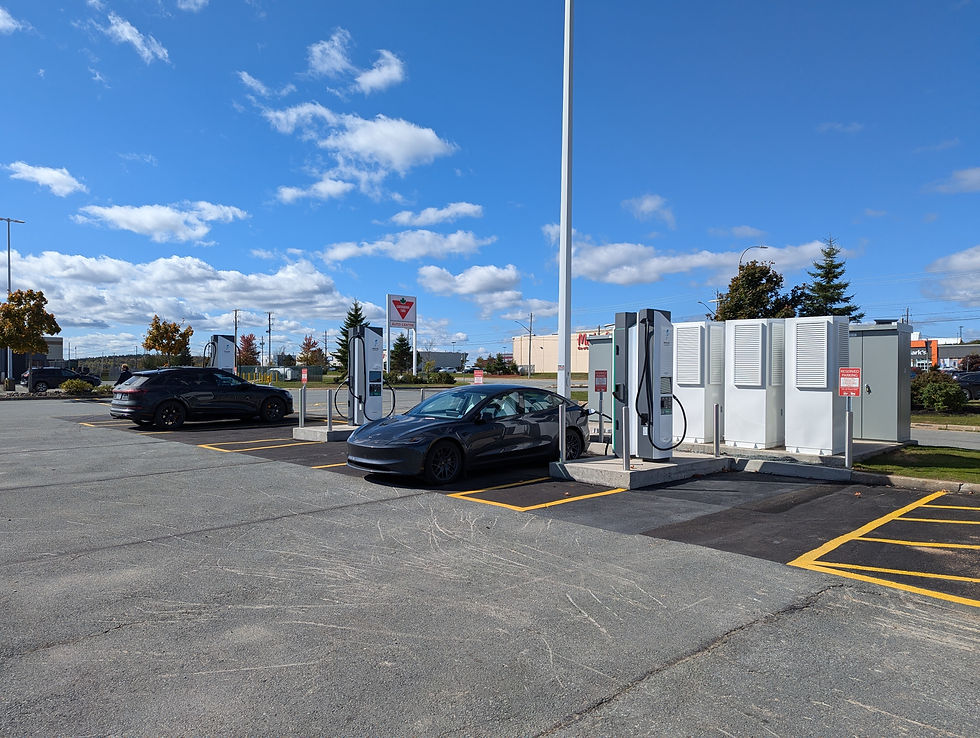
Providing organizations across Canada with rebates of up to 50% on purchase & installation costs of EV charging stations. Pollution Probe’s CHARGED Program is supporting the Government of Canada’s commitment to having Zero Emission Vehicles (ZEVs) comprise 50% of new passenger vehicle sales by 2030, and 100% by 2035. Accessible and abundant electric vehicle (EV) charging stations are vital for increasing EV ownership. To realize Canada’s targets, Canadians will need access to significantly more EV charging options than are currently available.
Electrify Nova Scotia Rebate Program - NS
Offered through the Province of Nova Scotia, the Electrify Nova Scotia MHZEV (Medium and Heavy-duty Zero Emission Vehicles) Rebate Program provides rebates for the purchase or lease of qualifying MHZEVs on or after April 1st, 2024.
The goal of the program is to accelerate zero emission vehicle adoption Nova Scotia by providing consumers with convenient and fast rebates on eligible medium and heavy-duty zero emission vehicles. This program is funded through the Department of Energy and administered by Clean Foundation.
SWTCH Energy - Free Home EV Charger
Canadian homeowners can get a free Level 2 EV charger plus 3 cents per kWh for charging your car at home. It's a simple way to turn your daily driving into annual earnings.
Offered through our partner SWTCH Energy, the program leverages The Canadian federal Clean Fuel Regulations (CFR) allowing EV charging on their network to generate credits, as it replaces higher-emission gasoline/diesel.
Property Assessed Clean Energy (PACE) - NS
Property Assessed Clean Energy (PACE) programs are a great way to finance energy efficiency upgrades and cleaner energy solutions for your home. Payments come from your energy savings. Now you can afford to make green choices.
SOLAR CITY PROGRAM - NS
The Solar City program offers property owners access to innovative solar energy options, which can be financed through a Local Improvement Charge. Property owners choose their preferred solar energy system and service providers as part of the program.
The Solar City program allows property owners to enter into an agreement with the municipality to access funds that offset the capital costs of installing solar energy systems on their property.
Net Metering
Net metering is the single biggest factor that makes residential solar work financially. While it isn’t a rebate, it directly reduces your electricity bill over time.
When your system produces more power than your home needs, that energy is sent back to the grid. You receive a one-to-one credit for every kilowatt-hour exported, which is then applied when your system produces less—such as at night or during winter months. The result is lower annual electricity costs and a system that works year-round, not just on sunny days.
Clean Technology Investment Tax Credit (ITC)
The Clean Technology Investment Tax Credit is one of the most significant financial incentives available to Canadian businesses investing in solar and other clean energy systems. Eligible projects can receive a 30 percent refundable tax credit based on the total capital cost of the system, significantly reducing upfront investment. Because the credit is refundable, businesses may receive a cash refund if the credit exceeds their tax liability, improving project cash flow and payback timelines. The program is currently available for projects placed in service between March 28, 2023 and December 31, 2034, with the full 30 percent rate remaining in effect until it begins to phase down after 2031.
Accelerated Capital Cost Allowance (CCA)
Accelerated Capital Cost Allowance allows businesses to recover the cost of solar and clean energy equipment much faster than traditional assets. Solar PV systems typically fall under CCA Classes 43.1 and 43.2, which benefit from enhanced depreciation rules designed specifically for clean energy investments.
For systems placed in service in 2026, businesses can often deduct up to 55 percent of the project cost in the first year, significantly reducing taxable income and improving early-year cash flow. By accelerating depreciation, CCA helps shorten payback periods and strengthens the financial case for commercial and industrial solar projects.
Community solar program
The Community Solar Program allows businesses, municipalities, and organizations to develop larger-scale solar projects—often referred to as solar gardens—without needing to offset power at a single meter.
These projects, typically ranging from 0.5 MW to 10 MW, generate electricity that is fed into the provincial grid and credited across multiple subscriber accounts or monetized through the sale of the project’s clean energy attributes. Community solar creates a flexible pathway for organizations to participate in clean energy development, generate long-term value from available land or rooftop space, and support broader decarbonization goals while improving energy cost predictability.
ADvancing clean technologies program (ns)
The Advancing Clean Technologies (ACT) for Nova Scotia Program is designed to help local agricultural producers adopt sustainable technologies that reduce greenhouse gas emissions, improve energy efficiency, and support climate change adaptation. Open to registered farms, Mi'kmaq farming communities, and agri-businesses with at least $30,000 in annual gross income, the program provides financial assistance for a wide range of projects including solar and wind energy, battery storage, high-efficiency heating and cooling, and LED horticulture lighting. Depending on your annual income, you may be eligible for maximum funding ranging from $50,000 to $150,000. As this is the final year for the program, interested applicants must submit their complete applications and project quotes by March 31, 2026.
.
Solar for Non-Profit Organizations
Efficiency Nova Scotia offers a dedicated solar rebate stream for registered non-profit organizations and charities, available for a limited time. Eligible projects can receive a rebate of up to $0.60 per watt (DC), covering up to 25 percent of eligible system costs (excluding HST), with a maximum rebate of $15,000 per organization.
Eligible system costs include the full installed cost of solar equipment and installation services, excluding HST. Systems must be installed after April 25, 2022 to qualify.
To be eligible, applicants must be a registered non-profit organization or charity and have been active for a minimum of 12 months. Organizations may be registered provincially or federally, including societies, non-profit cooperatives, limited guarantee companies, or registered charities.
Each organization may participate in the program once, and rebates are limited to one property per participant. The organization must own the solar equipment, though financed and lease-to-own systems are eligible.